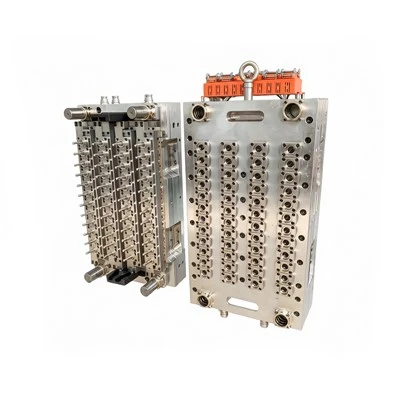
Hey folks, if you’ve ever shopped for PET preform molds—whether you’re a beverage brand gearing up for a new line of water bottles or a packaging manufacturer expanding your production line—you’ve probably noticed that price tags can swing pretty hard. Last week, I had a chat with a regular client who paid $8k for a 48-cavity mold a year ago, and just dropped $12k for a nearly identical one this month. Total head-scratcher, right? As someone who’s been supplying these molds for over a decade, I see this all the time, and it’s not just random markups. There are solid, science-backed factors that drive the cost, and I’m gonna break ’em down straight—no corporate jargon, no fancy fluff. PET Preform Mold

First up, and probably the biggest one: cavity count. That’s just the number of preforms a mold spits out per injection cycle, yeah? A tiny 4-cavity mold for small, niche batches is cheap—like, $2k-$3k. But cranking up that number? It’s not just multiplying parts. More cavities mean the mold base has to be bigger, the cooling lines have to be way more precise (you don’t want hot spots causing warped preforms mid-run), and the injection system (the part that feeds molten PET into each cavity) gets way more complex. Let’s say a 16-cavity mold is twice as much as a 4-cavity? Not even close—usually 4-5x more. We just did a 72-cavity mold last quarter, and that cost way more than a 24-cavity because we had to balance 72 individual injection points perfectly. Mess that up, and half the preforms are trash. So if you’re thinking “more cavities = better value,” just make sure your production line can keep up with the speed of a high-cavity mold, otherwise you’re wasting cash on something you can’t use.
Next, material quality. PET preforms are made from molten PET, which hits the mold at like 280°C (536°F) and is super corrosive. If you skimp on mold material, it’ll wear out way faster—you might get 500k cycles before it’s shot, vs. 2 million+ for a premium mold. The good stuff? Most of our mid-to-high-end molds use P20 steel for regular runs, or H13 steel for heavy-duty, high-volume work. Wait, and then there’s chrome plating—thicker, harder plating means less friction, less wear, cleaner preforms. A mold with thin chrome might cost $500 less up front, but you’ll be replacing it in 6 months instead of 2 years. I’ve had clients come back saying they saved money on a cheap mold, but they were down for maintenance twice as much. Quality material = longer lifespan, lower long-term cost. That’s a no-brainer, but a lot of folks fixate on upfront price only.
Then there’s precision of machining. This is where the rubber meets the road (pun very intended for plastics). Preforms have to fit on your bottle neck perfectly, no flashing (that extra plastic that sticks out), no inconsistencies in wall thickness. If the mold’s machining is off by even 0.01mm, you’ll have preforms that leak during blowing, or get stuck on your neck finishing equipment. We use 5-axis CNC machines for all our mold cavities now, which is a step up from the 3-axis most suppliers use. The extra cost for 5-axis? It adds 10-15% to the mold price, but the accuracy is night and day. I once had a client who bought a mold from a shop that used 3-axis, and half their preforms had uneven wall thickness—they had to rework every single one, which cost them more than the difference in mold price. Precision isn’t just a “nice to have”—it directly cuts down your downtime and waste, so it’s worth the investment.
Cooling system design is another underrated factor. When you inject molten PET, it has to cool fast and evenly, otherwise you get warped preforms, longer cycle times, and lower output. A cheap mold might have simple, straight cooling lines that are spaced too far apart. A good mold has conformal cooling lines—lines shaped exactly like the cavity, so every part cools at the same rate. For a 48-cavity mold, conformal cooling can add 20% to the cost, but it cuts cycle time by like 15% and boosts output by the same amount. So that higher cost pays for itself in a few months. I saw a client last year who went with a mold that had basic cooling—their cycle time was 10 seconds, vs. 8 seconds for a mold with conformal cooling. Over 10 million preforms a year, that’s a million more they can make with the same machine. Worth it, right?
Then there’s special features. If you need something custom, that’ll jack up the price. Let’s say you’re making a preform with a unique neck shape (maybe for a sports drink bottle with a sports cap), or you need a hot runner system instead of a cold runner. Hot runners heat the plastic right up to the cavity, so you have less waste from runner material—cold runners have extra plastic that gets recycled, which costs you material and waste disposal. A hot runner system adds 20-30% to the mold cost, but if you’re running 10 million preforms a year, the material saved pays for it in no time. Or if you need a mold that can handle a special PET blend, like for a food-grade bottle with extra UV resistance, that means modifying the mold’s surface to resist the blend’s corrosiveness—another cost add-on. And don’t forget mold bases: some clients want a modular mold base so they can swap cavities later, which is easier but costs more upfront. It’s all about what your specific production needs are.
Wait, and let’s not overlook lead time. If you need a mold in 2 weeks instead of the usual 6-8 weeks, you’re gonna pay a premium. We have a priority rush service, and that adds 15-25% to the cost because we have to drop other jobs, allocate extra machine time, and work overtime. A lot of brands need molds fast for a new product launch, but rushing it can also lead to more errors—we’ve had clients who rushed a mold, had defects, and had to replace it anyway. So unless it’s a true emergency, planning ahead saves cash here.
Another thing I see a lot: supplier expertise and after-sales support. A small shop that builds molds out of their garage might quote way lower, but if you have a problem with your mold at 2 a.m. during a production run, good luck getting a replacement part or troubleshooting over the phone. We offer 24/7 support, free maintenance training, and a 1-year warranty. That might make our mold 10% more expensive than a no-name supplier, but when your line is down and you need a new insert fast, that’s worth every penny. I had a client last year whose mold broke at 3 a.m.—we shipped a new insert same-day, and they were back up running by mid-morning. If they’d gone with the cheaper shop, they’d have been down for 3 days, costing them thousands in lost production.
Let me wrap this up with a quick takeaway: the cheapest mold isn’t always the best. The cost comes from a bunch of interconnected factors, not just “size” or “material.” If you’re planning to buy a PET preform mold, think about your production volume, how long you want the mold to last, your cycle time, and any custom needs you have. If you’re not sure where to start, feel free to reach out to work out what’s right for you. Don’t be shy to ask questions—we’ve been doing this for years, and we’re here to help you get a mold that fits your needs without overspending.
Cap Mold References:
- Rosato, D. V., & Rosato, M. G. (2004). Injection Molding Handbook. Kluwer Academic Publishers.
- Crawford, R. J. (2002). Plastics Engineering. Butterworth-Heinemann.
- PET Packaging Association. (2021. Annual Report on PET Preform Manufacturing Costs and Efficiency.
Taizhou Koni Mould Co., Ltd.
As one of the most professional pet preform mold manufacturers and suppliers in China, we also support customized service. Please feel free to wholesale high quality pet preform mold made in China here from our factory. For pricelist, contact us now.
Address: No. 97 Jinju Road, Chengjiang Subdistrict, Huangyan District, Taizhou City, Zhejiang Province
E-mail: kn@kenimould.com
WebSite: https://www.kenimouid.com/
